How it works
The gateway sits in front of what it protects. A protocol adapter (REST, MCP or A2A) turns the incoming message into a normalized action and resource, then every request passes the same checks, in order:
| # | Check | Fails with |
|---|---|---|
| 1 | Delegation chain: signatures, issuer, attenuation on every hop, time, audience, revocation | NX-1xxx, NX-3xxx |
| 2 | Proof of possession: signed by the leaf holder over the exact body, fresh, single use | NX-2xxx |
| 3 | Normalize: one exact action and resource; ambiguous messages are rejected | NX-5001 |
| 4 | Chain authority: the chain actually carries this capability, resource and value | NX-4032–NX-4034 |
| 5 | Trust: the receiving organization accepts this capability from the caller’s domain | NX-4031 |
| 6 | Policy: deny-overrides, default deny | NX-4035–NX-4038 |
| 7 | Approval: single-use human approval bound to the exact request, if policy asks | NX-4004 |
| 8 | Audit: one hash-chained event; if the write fails the decision becomes DENY |
NX-5003 |
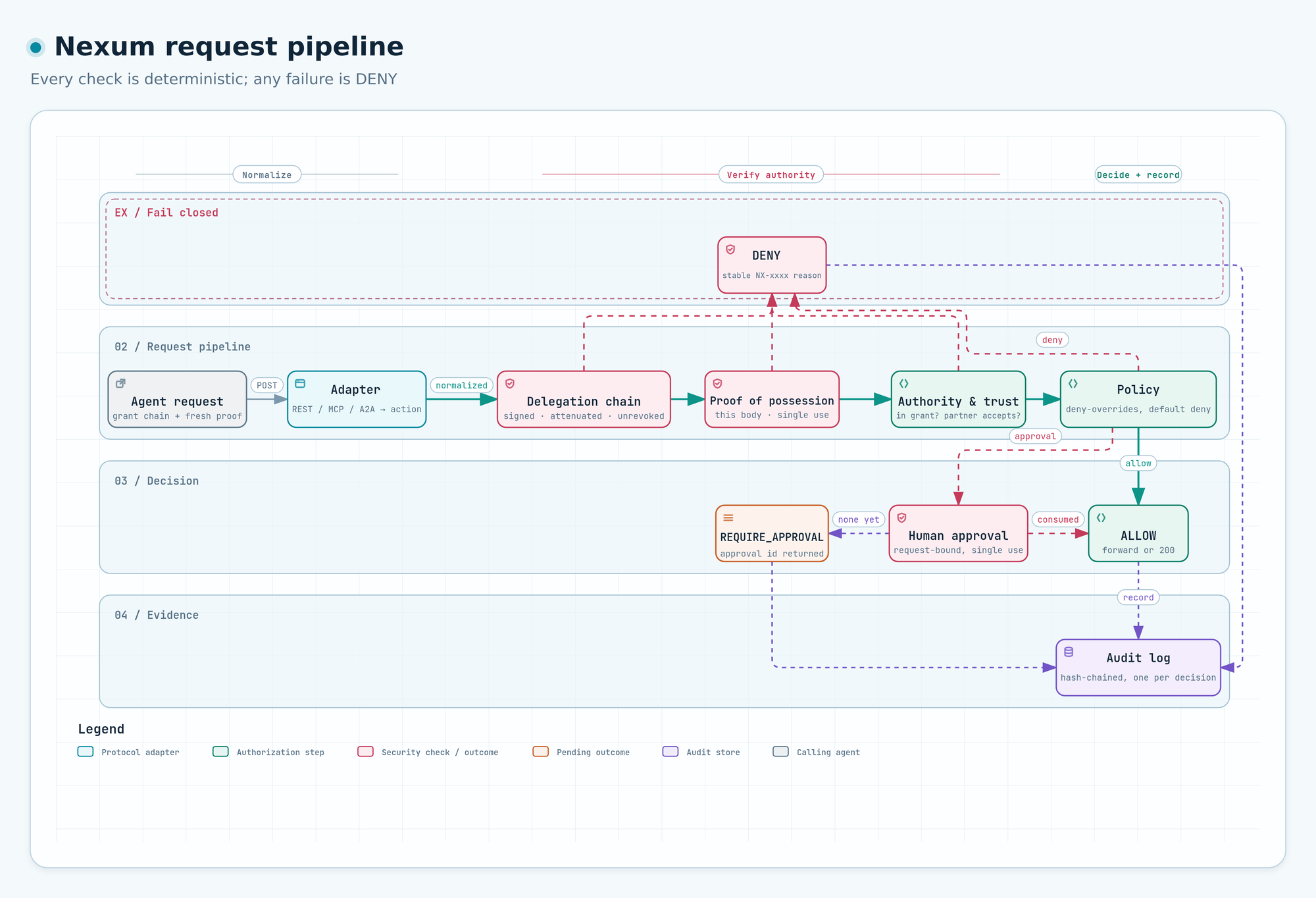
Policy runs after chain authority and trust, so policy can only narrow what the chain and the trust relationship already permit.
What is local
Section titled “What is local”Everything the gateway needs is a file the customer owns: trust.yaml,
policy.yaml, state.db (registry, revocations, approvals) and the audit log.
No call to any control plane is on the request path. A gateway can run as a
sidecar, a shared gateway, on a laptop, or air-gapped.
What is deliberately not here
Section titled “What is deliberately not here”Nexum is not an agent framework, an LLM, an IdP, a PKI, a policy language or a
transport. It sits between those and reuses their standards: SPIFFE IDs,
JWS/JWT, JWK, RFC 8693 act, RFC 7800 cnf, DPoP-style proofs, MCP and A2A.
See the full architecture.